
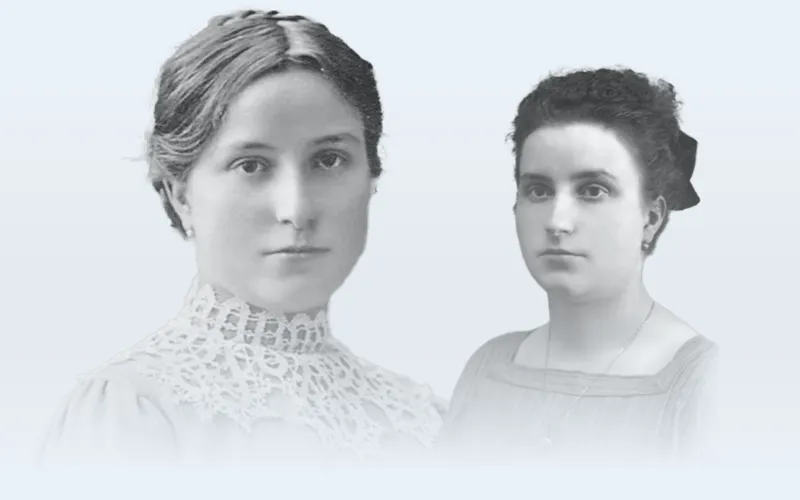
March 14, 1897 – The Birth
Maria Valtorta was born on March 14, 1897, in Caserta, where her parents, originally from Lombardy, were temporarily residing.
An only child, she grew up in a family with contrasting personalities: her father, a cavalry marshal, was a mild and accommodating man, while her mother, a French teacher, stood out for her rigid and authoritarian attitude.
Little Maria’s life had an start that was far from peaceful. After having already risked her life during childbirth, she was entrusted to a wet nurse with questionable behavior. The latter would even go so far as to leave her for hours in the sun-drenched fields, laying her among the wheat furrows in the countryside.
It was a childhood marked by shadows and difficulties that would inevitably contribute to shaping her soul and her path.
Early 1900s – Milan
The family’s constant relocations, dictated by the needs of the regiment in which her father served, profoundly marked the early years of Maria’s life. In fact, she spent her childhood between Faenza, in the heart of Romagna, and Milan, where she attended a kindergarten run by the Ursuline nuns.
It was precisely during that period that, despite her young age, Maria had a mystical experience destined to leave an indelible mark on her soul. She began to perceive a deep and inseparable connection between pain and love, even going so far as to desire to “console Jesus” by choosing to voluntarily embrace suffering out of pure love.
This thought became the very foundation of her spiritual journey.
1905 – Confirmation
In Milan, she began her elementary school education with the Marcelline nuns, immediately distinguishing herself as the top of her class.
It was in the same institute that, in 1905, she received the sacrament of Confirmation. On that occasion, Cardinal Andrea Ferrari, now Blessed, noticed the determination of her character and affectionately nicknamed her “Valtortino,” in recognition of an almost masculine strength of character.
She subsequently continued her elementary schooling in Voghera, attending the municipal schools.
During that period, she also undertook the study of the French language with some nuns who, exiled from France due to an anticlerical law, had found refuge in that very city.
October 1908 – First Communion
The same nuns took care of preparing her for her First Communion, which took place in Casteggio in October 1908, albeit in the absence of her father, whose presence her mother had considered superfluous. Deeply attached to her father by a strong affection, she suffered greatly from her mother’s arbitrary decision to send her away from home to a boarding school at the age of 12.
1909 – 1913 – Collegio Bianconi in Monza
It was the prestigious Collegio Bianconi in Monza, run by the Sisters of the Holy Child Mary, that served as the backdrop for her life during those years.
For her, that place became a true “nest of peace,” where she was able to fully satisfy her passion for study and discipline.
When, at sixteen years old, it was time to leave the boarding school, the words spoken by a Bishop during a sermon profoundly marked her path. It was then that she understood the Lord was asking her to dedicate herself to a life of penance and love, but without giving up her presence in the world.
After 1913 – Florence
Returning home, she found her father deeply affected, both in body and mind, to the point of being placed on early retirement.
Thus, the family decided to move to Florence. Maria settled in well in that vibrant city, rich in culture and art, which seemed tailor-made for her. She would often go out with her father to explore its wonders, sharing moments of rare beauty.
However, it was precisely in Florence that Maria experienced a bitter disappointment: her promising engagement to a distinguished young man she had recently met was abruptly cut short by her mother’s rigid and severe attitude, extinguishing right from the start a chapter that seemed full of hope.
1917 – 1920 – The Great War
In Florence, in 1917, during the First World War, she joined the corps of volunteer nurses, known as the Samaritans, working in military hospitals to assist wounded soldiers.
That experience proved to be profoundly formative for her.
On March 17, 1920, in Florence, while walking near her home with her mother, she suffered a violent attack. A young delinquent, shouting slogans against the “upper class” and the “military,” brutally struck her in the kidneys with an iron bar. This attack caused her excruciating pain and confined her to bed for three months.
1920 – 1922 – Reggio Calabria
She had the fortunate opportunity to spend two years in Reggio Calabria, away from her parents, hosted by her mother’s cousins, who were wealthy owners of two hotels.
Their sincere affection and the natural beauty of the place reinvigorated her. During that stay, she felt new impulses toward a life rooted in Christ. However, her mother, despite being far away, continued to wound her feelings as a woman, and the return to Florence in 1922 brought back “bitter memories.”
1924 – Viareggio
In 1924, her parents bought a house in Viareggio, where the family moved and settled permanently. It was precisely there that a path of intense spiritual growth began for Maria, characterized by deep commitment and total dedication, which translated into firm decisions and culminated in extraordinary offerings of herself out of love for God and for the good of humanity.
January 4, 1933 – The Definitive Infirmity
Tested by harsh experiences, including her commitment as a cultural delegate in the parish Catholic action, where in 1929 she joyfully dedicated herself to instructing young women through the light of the Gospel, her health became an increasingly heavy obstacle to face.
Despite her growing fragility, she never let herself be discouraged and continued to support the parish apostolate and charitable works with great tenacity. Her love for God and for souls ultimately led her to make the heroic choice of offering herself completely as a victim of divine love and justice.
Her physical sufferings also stemmed from the traumatic event of March 17, 1920. Since then, a progressive paralysis in her lower limbs made her movements increasingly difficult. On January 4, 1933, she left her home for the last time, accepting with faith even the martyrdom of confinement.
But it was on Easter day in 1934 that the illness completely prevailed, rendering her entirely bedridden. Her life, marked by physical and spiritual sufferings, remained until the very end an extraordinary example of dedication and selfless love.
1935 – Marta Diciotti and the Death of Her Father
On May 24, 1935, a young woman named Marta Diciotti, left orphaned and alone, was welcomed into the Valtorta household.
Over time, Marta became her trusted assistant and confidante, remaining by her side for the rest of her life. Just a month later, on June 30, Maria faced the loss of her beloved father, a pain so great that it made her fear for her own survival.
1943 – Her Memoirs
In the early months of 1943, at the invitation of her spiritual director, the Servite father Romualdo M. Migliorini, Maria Valtorta began writing the memoirs of her life. This devout religious man had visited Maria in June of the previous year and, from that moment on, became her confessor and spiritual guide for almost four years.
With surprising speed and spontaneity, she filled seven notebooks for a total of 761 pages, recounting in epistolary form and without reservation “all the good and all the bad” of her existence up to that point.
April 23, 1943 – The First Dictation
With the delivery of her Autobiography to her confessor, Maria Valtorta seemed to have definitively freed herself from the weight of the past.
This act allowed her to face the prospect of death with greater serenity and trust, convinced that she had already offered every possible sacrifice. But it was precisely at that moment that a voice familiar to her spirit dictated to her a page imbued with divine wisdom, marking the beginning of a completely unexpected turning point.
It was April 23, 1943, Good Friday.
From 1943 to 1951 – The Dictations
Comforted by Father Migliorini’s words regarding the supernatural nature of the “dictation,” Maria Valtorta continued to dedicate herself diligently to writing, using the notebooks that the father himself had provided for her.
With the same approach adopted for the writing of her Autobiography, remaining in bed, she wrote almost daily until 1947.
In the following years, she continued intermittently until 1951, filling a total of 122 notebooks with an impressive 13,193 pages. Her working method was astonishing: she wrote fluidly and uninterruptedly, in one go, by inspiration, as if transcribing events and scenes she was witnessing in real time.
She did not rely on outlines or preparatory drafts, and often she had no idea what would flow from her pen the next day. The only reference materials she consulted were the Bible and the Catechism of Pius X, avoiding any other source or text.
October 4, 1943 – Death of Her Mother
Her mother, whom she always loved out of natural duty and with a supernatural sentiment, as she attests multiple times in her writings, died on October 4, 1943, without ever having ceased to torment her daughter.
April 1944 – The Second World War
She did not interrupt her activity even when, during the tumultuous days of the Second World War, she was forced to leave Viareggio to seek refuge in Sant’Andrea di Compito, a hamlet of Capannori in the province of Lucca. Here she spent a difficult period due to her condition as an invalid and a displaced person from April to December 1944, having moved along with the furniture of her room, facing a new burden of suffering.
March 14, 1947 – The Isolation
Nearing the end of the drafting of her major Work, destined to become a literary and spiritual monument under the title “The Gospel as Revealed to Me,” Maria Valtorta found herself dealing with a profound feeling of longing for her beloved Lord. Fearing she would no longer be able to see Him after the conclusion of that immense work, she was seized by a sort of spiritual melancholy.
But right in that delicate moment, He appeared to her with words capable of instilling sweetness and hope: He promised her that He would always return to meet her, this time in an even more intimate and gentle way, dedicating Himself entirely to her. He told her that He would elevate her toward the spheres of pure contemplation, leaving her immersed in the bliss of His love.
It was March 14, 1947, a particularly special date for Maria: the day of her fiftieth birthday. Just a month later, on April 18, Maria Valtorta entrusted to a letter addressed to her spiritual guide, Mother Teresa Maria of Saint Joseph, a profound confession of her inner journey. In that writing, she revealed that she had offered all of herself to God, even her intellect.
This further gift represented an act of total abandonment and trust in the hands of the Lord, highlighting how her relationship with God had by now become pure and absolute. An intimate testimony from the heart of a life consecrated entirely to divine love.
October 6, 1952 – The Imprimatur and Publication
Maria Valtorta, after fighting for a long time for her mission, decided to give up on publication with an imprimatur. Driven by the desire to have her Work reach souls and respecting the will of Jesus, she chose to entrust its publication and dissemination to the Tipografia Editrice M. Pisani in Isola del Liri.
On October 6, 1952, in Viareggio, the publishing contract was signed, initiating a fruitful collaboration between Maria Valtorta and Michele Pisani, who entrusted his son Emilio Pisani with managing the project.
Since then, the Work began to take shape, and the commitment to its dissemination has remained alive and uninterrupted for over seventy years.
Summer 1956 – The Contemplative State
In the summer of 1956, with the publication of the first volume of her work, Maria Valtorta’s gradual and inexplicable psychological detachment began.
As time passed, she slipped into a state of passive quiet, almost contemplative, giving up any concrete activity. For a brief period, she returned to writing, but she limited herself to filling small holy cards and sheets of paper with the short prayer, “Jesus, I trust in you,” repeated endlessly in minute, precise handwriting. Her ability to converse with others vanished; she answered only by repeating the last words of the sentences spoken to her.
From time to time, almost as if stepping out of her inner isolation for an instant, she would let out a spontaneous exclamation: “What bright sunshine there is here!”
Only in two or three fleeting moments did she seem to become completely lucid again, responding to important questions with incisive and perfectly sensible statements.
Despite the slowness of her gestures and the strange quiet that had enveloped her, her face never betrayed a shadow of distress: her gaze always remained lively and bright, and her expression profoundly serene, as if a pervasive inner peace had remained intact within her, even in her most enigmatic moments.
October 12, 1961 – The Ascent to Heaven
Following the words of the priest who was reciting the prayer for the dying, “Depart, O Christian soul, from this world,” Maria Valtorta left this life on October 12, 1961. She was 64 years old and had spent the last 27 and a half years confined to bed.
July 2, 1973 – Back to Florence, Forever
Twelve years later, on July 2, 1973, the mortal remains of Maria Valtorta were transferred from the Camposanto della Misericordia in Viareggio and entombed in Florence, inside the Chapter chapel located in the Great Cloister of the Basilica-Sanctuary of the Santissima Annunziata. Presiding over the ceremony was the renowned Mariologist Father Gabriele Maria Roschini, belonging to the Order of the Servants of Mary.
Today – The Tomb at the Santissima Annunziata
The house where she lived in Viareggio and the tomb in Florence continue to discreetly welcome the readers of her works, who arrive from every corner of Italy and the world. In the guestbook, devotees leave touching and moving testimonies of gratitude and affection, often accompanied by requests for special graces.